Published by:
CGP EDU Academic Team
Published on: September 12, 2026
A wedge is kept over a frictionless horizontal surface. A block is placed at top ‘A’ and slips to
bottom ‘B’ of the wedge all surface are frictionless. Then during the motion of block from ‘A’ to ‘B’
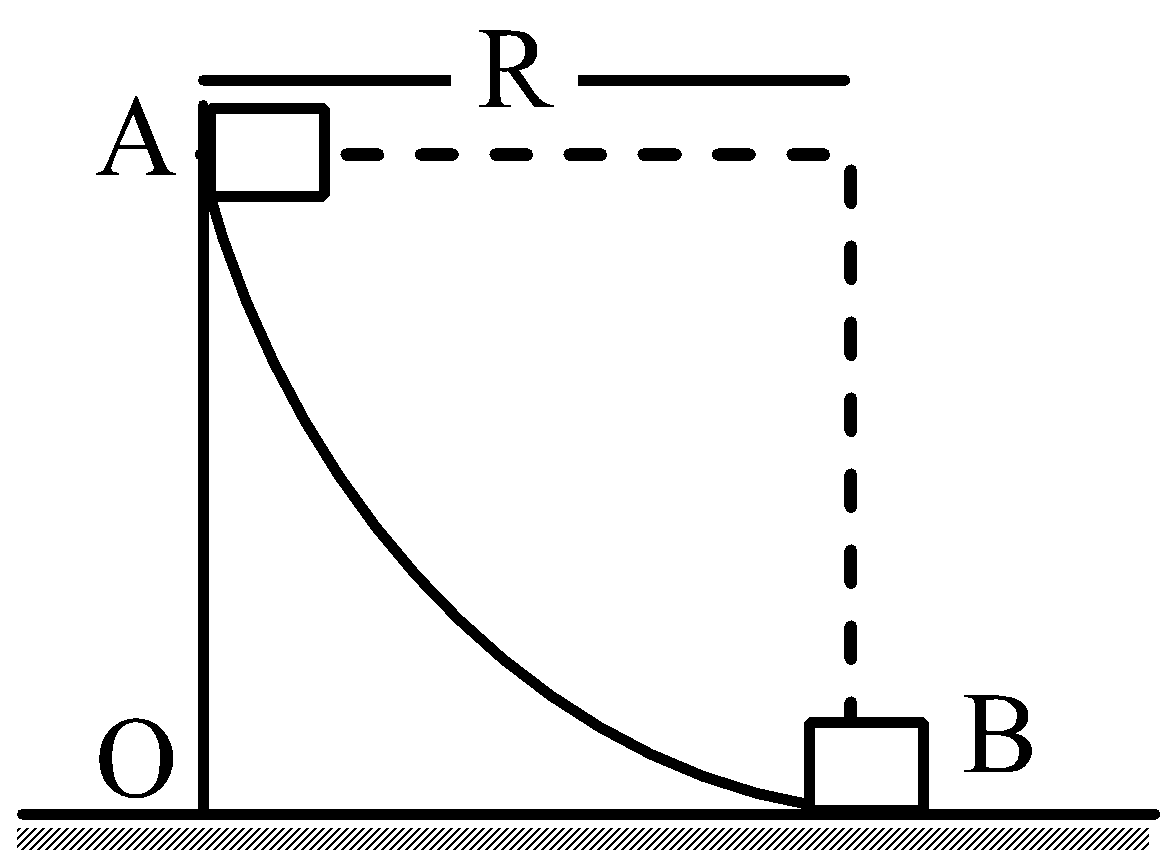
Column-I | Column-II |
(i) Magnitude of momentum of block+ wedge system in horizontal direction | [A] Conserved |
(ii) Mechanical energy of block | [B] Not conserved |
(iii) Magnitude momentum of block+wedge system | [C] Increases |
(iv) Angular momentum of block about ‘O’ | [D] Decreases |
Text Solution
Verified by ExpertsThe correct answer is:
A
Step 1: Understanding the System
In this scenario, we have a block sliding down a wedge on a frictionless surface. The entire system (block + wedge) is isolated horizontally, meaning there are no external horizontal forces acting on it.
Step 2: Conservation of Momentum
Since there are no external forces acting horizontally, the horizontal momentum of the system (block + wedge) will be conserved throughout the motion. Therefore, the magnitude of momentum of the block + wedge system in the horizontal direction is conserved, which corresponds to the option [A].
Step 3: Mechanical Energy of the Block
The mechanical energy of the block is not conserved because as the block slides down, gravitational potential energy is converted into kinetic energy. However, some of this kinetic energy will increase the wedge's kinetic energy as well possibly, due to the block moving downwards. Thus, option [B] is correct for mechanical energy, but not for the momentum situation.
Step 4: Analyzing Momentum
The momentum of the entire block-wedge system remains constant over time (horizontally), thus its magnitude does not increase (contrary to option [C]). Option [D] regarding angular momentum of the block about point O needs to be analyzed: which should actually stay constant as long as the wedge doesn't gain significant rotation.
Therefore, we conclude that:
Magnitude of momentum of block + wedge system in horizontal direction is conserved (Option A).
In this scenario, we have a block sliding down a wedge on a frictionless surface. The entire system (block + wedge) is isolated horizontally, meaning there are no external horizontal forces acting on it.
Step 2: Conservation of Momentum
Since there are no external forces acting horizontally, the horizontal momentum of the system (block + wedge) will be conserved throughout the motion. Therefore, the magnitude of momentum of the block + wedge system in the horizontal direction is conserved, which corresponds to the option [A].
Step 3: Mechanical Energy of the Block
The mechanical energy of the block is not conserved because as the block slides down, gravitational potential energy is converted into kinetic energy. However, some of this kinetic energy will increase the wedge's kinetic energy as well possibly, due to the block moving downwards. Thus, option [B] is correct for mechanical energy, but not for the momentum situation.
Step 4: Analyzing Momentum
The momentum of the entire block-wedge system remains constant over time (horizontally), thus its magnitude does not increase (contrary to option [C]). Option [D] regarding angular momentum of the block about point O needs to be analyzed: which should actually stay constant as long as the wedge doesn't gain significant rotation.
Therefore, we conclude that:
Magnitude of momentum of block + wedge system in horizontal direction is conserved (Option A).
Prepare Smarter with CGP Edu
Get practice questions, solutions, and test series in one place.
Write a Review
Share your experience with this question and solution.
Commentary
Send your comment, doubt, correction, or feedback to admin.
Similar Questions
Explore conceptually related problems
A block of mass M is pulled along a horizontal frictionless surface by a rope of mass m. If a force…
Two masses of 4 kg and 5 kg are connected by a string passing through a frictionless pulley and are…
Two masses 2 kg and 3 kg are attached to the end of the string passed over a pulley fixed at the to…
Three blocks A, B and C weighing 1, 8 and 27 kg respectively are connected as shown in the figure w…
Two bodies of mass 3 kg and 4 kg are suspended at the ends of massless string passing over a fricti…
Three solids of masses m_1, m_2 and n_3 are connected with weightless string in succession and are …